Documentation Index
Fetch the complete documentation index at: https://mintlify.com/asimovinc/asimov-v0/llms.txt
Use this file to discover all available pages before exploring further.
What is Asimov?
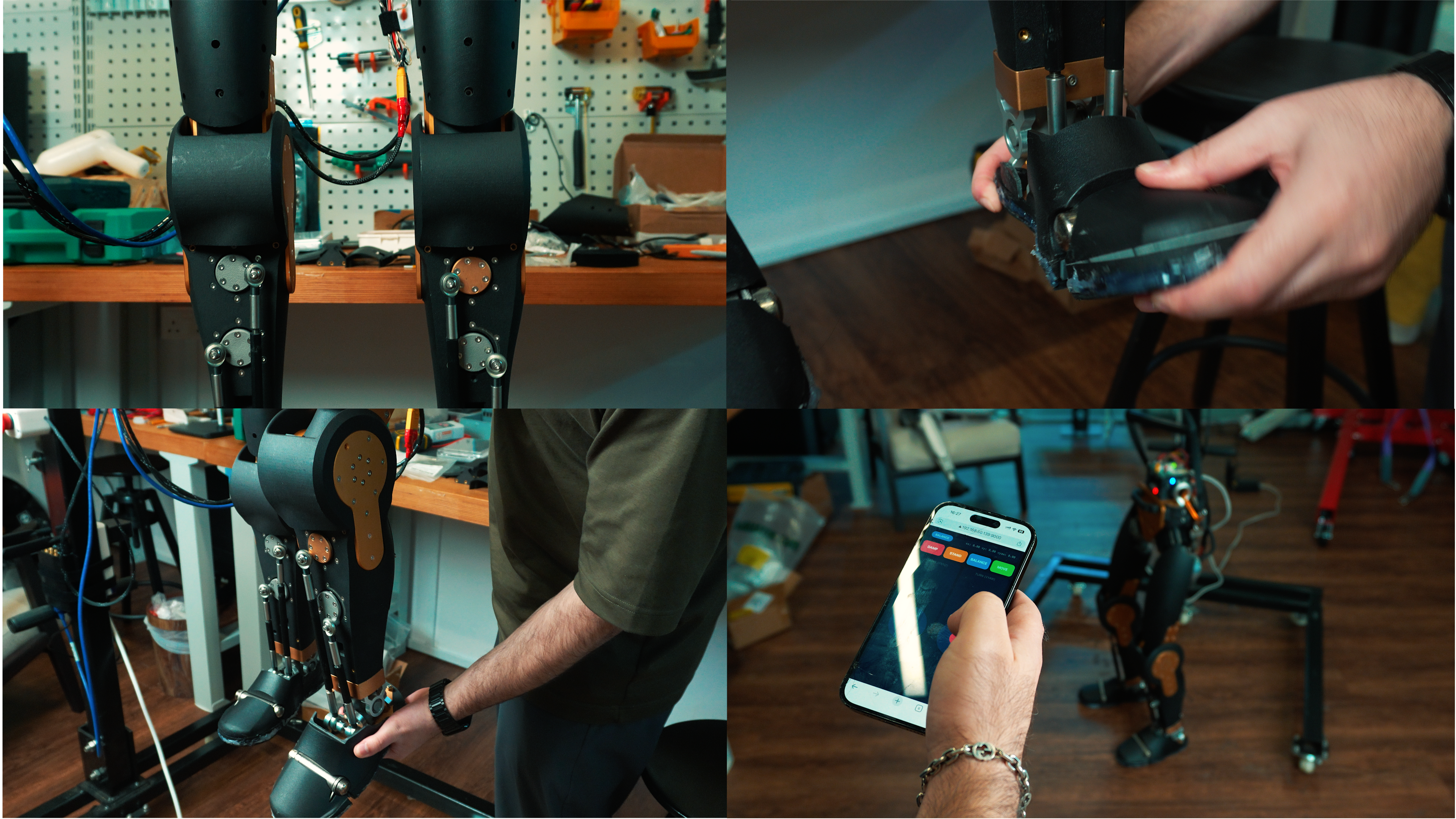
Asimov v0 is a complete bipedal leg system for humanoid robots, designed and built by Menlo Research as an open-source platform. It represents a practical approach to building humanoid robot legs using off-the-shelf components and manufacturing processes suitable for low-volume production.Asimov is fully open-source, including mechanical designs, simulation models, and control algorithms. The project is designed to be accessible to researchers, hobbyists, and companies looking to build or prototype humanoid robots.
Key Features
Asimov v0 is engineered with several advanced features that make it a capable platform for bipedal robotics:12 DOF Actuation
Six degrees of freedom per leg, providing the full range of motion needed for natural walking, running, and dynamic movements.
RSU Ankle Mechanism
Revolutionary Spherical Universal ankle design that provides exceptional dexterity and stability while maintaining a compact form factor.
Articulated Toe
Each foot features an articulated toe joint with passive compliance, enabling more natural gait patterns and improved energy efficiency.
MJF 3D Printing Compatible
All structural components are optimized for Multi Jet Fusion (MJF) 3D printing, making the design accessible for low-volume manufacturing.
Degrees of Freedom Breakdown
Each leg consists of six actuated joints:- Hip Pitch - Flexion and extension movements (forward/backward swing)
- Hip Roll - Abduction and adduction movements (lateral sway)
- Hip Yaw - Internal and external rotation
- Knee Pitch - Flexion and extension (leg bending)
- Ankle Pitch (A) - Dorsiflexion and plantarflexion via coupled mechanism
- Ankle Roll (B) - Inversion and eversion via coupled mechanism
- Toe - Passive spring-loaded articulation
Understanding the RSU Ankle Mechanism
Understanding the RSU Ankle Mechanism
The Revolute Spherical Universal (RSU) ankle mechanism is a key innovation in Asimov v0. Unlike direct-drive ankles, the RSU design uses two motors (A and B) connected through parallel linkages to control both pitch and roll movements.This coupled mechanism provides:
- Reduced weight at the end of the leg
- Better force distribution
- Compact packaging
- High torque capacity for both pitch and roll
Use Cases and Applications
Asimov v0 is designed to support a wide range of applications in bipedal robotics research and development:Research & Development
- Locomotion Research - Study bipedal walking, running, and dynamic balance algorithms
- Control Systems - Develop and test advanced control strategies for humanoid robots
- Machine Learning - Train reinforcement learning agents for bipedal locomotion
- Gait Analysis - Investigate biomechanics and energy-efficient walking patterns
Prototyping & Production
- Humanoid Robot Development - Use as a reference design or direct integration into full humanoid platforms
- Service Robots - Build mobile robots for tasks requiring human-like mobility
- Entertainment & Research Platforms - Create demonstration platforms or educational tools
Education
- Robotics Education - Teach principles of legged robotics, kinematics, and control
- Open-Source Community - Contribute to and learn from an active development community
Manufacturing Approach
Asimov v0 is specifically designed to be manufacturable with accessible technologies and off-the-shelf components.
- MJF 3D Printing - All structural parts are optimized for Multi Jet Fusion additive manufacturing
- Off-the-Shelf Motors - Uses Encos actuators that can be sourced commercially
- Standard Fasteners - Common screws, bearings, and hardware components
- Low-Volume Production - Designed for small batch manufacturing rather than mass production
Getting Started
To begin working with Asimov v0:Review Specifications
Familiarize yourself with the joint specifications, range of motion, and torque capabilities to understand the platform’s capabilities.
Explore the Mechanical Design
Access the full mechanical CAD files and assembly instructions in the GitHub repository.
Set Up Simulation
Use the provided MuJoCo simulation model to test control algorithms before working with physical hardware.
Community and Support
Asimov is an open-source project maintained by Menlo Research with support from a growing community:Website
Official project website with latest updates and resources
Discord Community
Join the community to ask questions, share projects, and collaborate
GitHub Repository
Access all source files, CAD models, and simulation code
Early Access Support
Support development and get early access to updates
Project Background
Asimov v0 is developed by Menlo Research, a robotics research organization dedicated to advancing humanoid robotics through open-source collaboration. By making the complete design files and specifications publicly available, the project aims to accelerate innovation in bipedal robotics and make humanoid robot development more accessible to the wider robotics community.For partnerships and commercial inquiries, contact: hello@menlo.ai
Next Steps
Ready to dive deeper? Explore the detailed technical specifications:View Complete Specifications
Joint ranges, torque specifications, motor models, and kinematic parameters